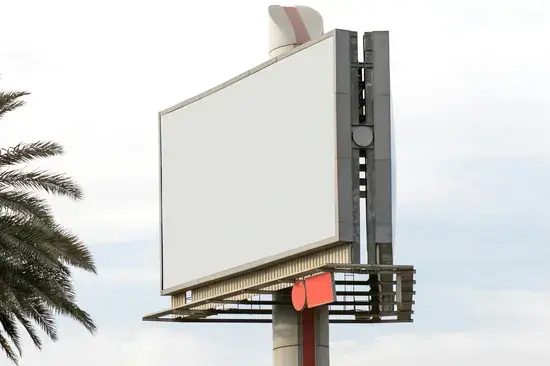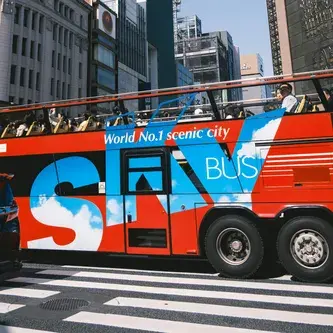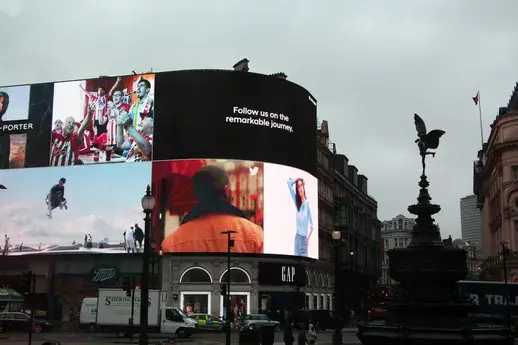
An outdoor advertising marketplace is the simplest definition you can give: a website where you see the price of a billboard, click it, and book it. No quote request. No agency call. No "we'll get back to you in three days." Just the rate, the photo, the location, and a button. That is the whole pitch. And it is the reason most SMBs in 2026 should stop calling agencies for single-city outdoor buys. Out-of-home advertising covers the category this marketplace model sits inside, if the format history is useful background.
Here is the short version. An OOH marketplace aggregates inventory from many owners, shows transparent pricing on every listing, and lets advertisers self-serve through booking and payment. In the USA, AdQuick covers static and digital with a quote-and-shortlist flow. Blip runs a programmatic-auction model where you set a daily budget and your ad rotates across screens. Vistar Media and Place Exchange are SSP and DSP infrastructure that agencies plug into. AdTown is the only true direct-booking marketplace in OOH, India and USA, where you see the listing, the photos, the rate card, and click to book a specific board. It is built for SMBs running their first campaign and for brand teams at larger companies that just want to skip the agency layer. Campaigns start from around ₹4,000 a month in India and from $50 in the USA. For most one-city or two-format buys, the marketplace route beats the agency on price, speed, and clarity.
The rest of this guide explains how marketplaces actually work, who they suit, where they fall short, and what a real booking flow looks like end to end.
What a marketplace is, in OOH context
A marketplace is a two-sided platform. Owners list inventory. Advertisers browse and book. The platform handles the discovery layer, the payment escrow, the proof of play, and the standardisation of listings so a hoarding in Bandra and a hoarding in Atlanta look comparable on the same screen.
Compare that to the two older models.
The traditional agency model is intermediated. You brief the agency. The agency sources inventory from owners, builds a plan, marks the media up 15 to 25 percent, charges a retainer of ₹50,000 to ₹2,00,000 a month in India or $5,000 to $25,000 a month in the USA, and runs the campaign. Good for complex multi-city integrated work. Heavy for a single-city hoarding buy.
The direct-from-owner model is also old. You call the owner of the board, you negotiate, you sign a paper contract, you pay by cheque or wire, you ship the flex. No markup, but limited to that one owner's inventory. Most owners in India own 20 to 200 units. You'd need to call 15 owners to compare the same corridor.
A marketplace sits between them. It is direct-from-owner pricing, with the breadth an agency would have given you, and the speed of a software product. That is the whole structural change.
How transparent pricing changes the buyer
In a non-marketplace world, the OOH buyer never knows the real price. You ask the agency, they come back with a number that includes a markup. You ask another agency, you get a different number with a different markup. You ask the owner, you get a third number, which may be lower or higher depending on whether the owner thinks you're a big spender.
A marketplace fixes this in one move: the listed number is the booking number. Whoever clicks first at the listed rate, books it. No haggling. No back and forth. No "let me check with my manager."
The first time you use a marketplace this feels strange. The second time it feels obvious. By the third time the older models feel like calling a taxi dispatcher in 2007 instead of opening an app.
What self-serve booking actually looks like
A typical marketplace booking goes like this.
- Filter by city, format, budget, and dates. You see a grid of listings with photos, the unit code, the size, the location, the impressions estimate, and the rate.
- Click into the unit. You see the full photoset, the visibility cone, the cycle dates, what is included (printing, pasting, monitoring), and any restrictions.
- Upload your creative or pick "designer needed later." If you upload, the system checks dimensions and resolution.
- Pay. Money is held in escrow.
- Owner confirms installation. Photos with date stamps land in your dashboard.
- Campaign runs. Mid-flight photos at predetermined intervals confirm the unit is still up.
- Campaign ends. Payout releases to the owner.
The whole booking, from search to confirmation, takes about 20 minutes if you know what you want. The agency equivalent is two weeks of back and forth, three phone calls, and an invoice you can't audit.
The major marketplaces in 2026
The USA market has matured. The names worth knowing:
- AdQuick. The biggest aggregator of static and digital OOH across the USA. Many buys go through a quote-and-shortlist flow, with a self-serve layer for shorter campaigns. Four-week rotations start under $1,000 in smaller markets and run $3,500 to $25,000 in major metros. Strong inventory depth.
- Blip. Programmatic-auction DOOH on a daily-spend model. You set a budget, and your ad rotates across screens in a network. You do not pick a specific board for a specific date. Campaigns can start with $50, and a proper small-market campaign typically runs around $600 a month. Best for creative tests and broad coverage.
- Vistar Media. SSP and DSP infrastructure that agencies and large buyers plug into. It powers a lot of the programmatic plumbing other tools sit on top of. Not a destination most advertisers book on directly.
- Place Exchange. The DOOH SSP that connects supply to demand-side platforms. Again, infrastructure for agencies, not a booking destination for an advertiser walking up cold.
In India, the market is just opening up. AdTown is the first true direct-booking marketplace in India, with broad coverage across Mumbai, Delhi NCR, Bangalore, Hyderabad, Chennai, and beyond. You see the listing, the photos, the rate, and you click to book the specific unit for the specific dates. Like Airbnb for ad spaces. There are a handful of legacy "directories" that list units but don't actually let you book online. They are not really marketplaces, they are lead-gen for the same agencies you were trying to skip.
AdTown also runs across the USA with a partner-deep Detroit market and growing inventory in NYC, LA, Chicago, Houston, and Atlanta.
Where marketplaces fall short
This part doesn't always get said. A marketplace is not the right tool for every campaign.
Inventory depth at launch. A new marketplace in a growing market has fewer units listed than a 30-year-old agency with everyone's number saved. AdTown, for example, has deep Detroit inventory in the USA, growing coverage in the other metros, and is still adding units in tier 2 Indian cities. What you do get, even at this stage, is the direct-book model. You see the unit, you book the unit. If your campaign needs 40 specific spots across 12 cities right now, an agency may still beat the marketplace on availability alone, but for most one or two city buys the listed depth is already where you need it.
Limited hand-holding. A marketplace doesn't write your brief, doesn't audit your creative, doesn't run your media plan, and doesn't argue with the owner about late installations. If you've never bought outdoor before, that learning curve is real. Most first-time buyers figure it out inside two campaigns, but it isn't zero effort.
Complex multi-channel coordination. A marketplace is built for OOH. If you're orchestrating a campaign that touches TV, print, OOH, digital, influencer, and PR with synchronised timing, an integrated agency is still earning its fee. The marketplace handles the OOH layer cleanly, but you'd still need someone owning the calendar across channels.
Creative. Marketplaces sell media, not creative. You either bring your own designer or pay a freelancer. Most marketplaces have a design partner network for this, but the cost is separate from the booking.
If you read the do I need an advertising agency guide, the trade off is the same one in detail. Marketplaces win on simple buys. Agencies win on complexity. Most brands now run hybrid.
A worked example: bookstore launch in Hyderabad
Say you're opening a new bookstore in Jubilee Hills, Hyderabad. Budget: ₹80,000 over 30 days.
Old agency route: brief the agency, three day quote turnaround, ₹80,000 media plus 18 percent markup (₹14,400) plus a one-off retainer of ₹35,000 because the agency won't take you under ₹3 lakh a month otherwise. Total: ₹1,29,400. Or they decline the brief entirely because it's too small.
Marketplace route on AdTown: filter Hyderabad inventory, ₹80,000 budget, 30 day cycle. You see roughly 25 options. Pick one mid-tier hoarding on the Jubilee Hills to Banjara Hills corridor for ₹45,000, plus three indoor screens at Jubilee Hills cafes for ₹20,000, plus 8 auto rickshaw hood panels rotating through the area for ₹12,000, plus ₹3,000 left for printing the flex. Designer is a separate ₹6,000 freelance brief. Total: ₹86,000 with the design, against ₹1,29,400 from the agency. You also keep total visibility into what's running where, and you'd see this same approach more deeply in the billboard cost India guide.
That ₹43,400 gap is rent for half the store for the first month. The marketplace wins.
Programmatic DOOH inside the marketplace
The newer wrinkle. Most modern marketplaces don't just sell static and digital placements, they also surface programmatic DOOH alongside. You can book a fixed-rate hoarding for ₹45,000 on the same page where you set up a Blip-style $50 programmatic test. The point of buying through the same platform is that you don't have to context-switch between four logins, two payment methods, and three different reporting dashboards.
This is also where the marketplace edge over agency widens. Programmatic DOOH was always going to be a self-serve channel. An agency that takes 15 percent of your daily $50 Blip spend is doing nothing useful for the cut.
How the booking flow protects both sides
A common worry: "What if I pay and the unit never goes up?"
Marketplaces solve this with escrow plus proof of play. Your payment sits with the platform until the owner confirms installation with date-stamped photos. The owner can't pocket the money and ghost. If installation never happens, the platform refunds you. If the owner installs and the unit comes down early, mid-flight monitoring catches it.
The reverse is true too. An advertaiser who ships dirty creative or asks for changes 12 days into a 30 day cycle can't burn the owner's time without paying. The contract is enforced by the platform.
For brand-new marketplaces this is the single most important piece. Trust between two parties who've never met is the whole reason a platform exists. Without it the marketplace is just a directory.
Where this is heading
Three trends worth watching in 2026.
First, programmatic DOOH is going to keep taking share from static booking. The buying experience is closer to Google Ads than to a hoarding contract, and the under-thirty marketing teams running most SMB ad spend now prefer that.
Second, marketplaces are starting to cross sell across formats. The same advertiser buying a hoarding might also book a mall LED, a cinema slide, and a transit wrap in one cart. This collapses the historical fragmentation of OOH into a single buying surface.
Third, agencies are repositioning. The smart ones are not fighting the marketplace, they're using it. They keep the strategic and creative work, and run the tactical media buys through marketplaces themselves. The brands that ignore this and keep paying full markups are going to look very expensive in two years.
Where AdTown fits
AdTown is built for the buyer who wants the direct-booking marketplace experience without learning the differences between four overlapping USA platforms. You see the listing, the photos, the rate, and you click to book the specific board for the specific dates. India and USA inventory in one place. Transparent pricing on every listing. Booking, escrow, and proof of play handled in the same dashboard. Built for advertisers of every size: SMBs running their first campaign, lean brand teams at larger companies, brand managers wanting to skip the agency layer. And free to use for the first six months while the platform launches, so during that window the owner keeps the full booking amount and the advertiser pays no platform fee.
If you've never used a marketplace before, browse /listings and filter by your city. Even if you don't buy on the first visit, seeing real prices on real units changes how you think about every quote you get afterwards. That is most of the value. The next steps after that are how to plan an OOH campaign for the actual planning sequence and the OOH advertising budget guide for sizing the spend.
The "should I use an outdoor advertising marketplace" question used to be hard. In 2026 it has a simple answer: yes for almost any single-city or single-format buy, and a real consideration for everything else.
Whichever side of the marketplace you're on
Browse listings if you want to advertise. List your space if you have a wall, window, screen, or hoarding to monetise.
Frequently asked questions
An outdoor advertising marketplace is a two-sided platform where space owners list billboards, hoardings, indoor screens, transit, and cinema slots with transparent pricing, and advertisers browse, compare, and book without going through an agency. The marketplace handles discovery, payment escrow, and proof of play. Pricing is shown upfront on every listing. Self-serve booking means a first-time advertiser, or a brand manager at a larger company tired of the agency model, can run a real campaign in a week without a salesperson involved. AdQuick uses a quote-and-shortlist flow for many buys, Blip runs a programmatic-auction rotation, and Vistar Media and Place Exchange are SSP and DSP infrastructure for agencies. AdTown is the only true direct-booking marketplace covering India and the USA, where you see the listing, the photos, the price, and click to book.
Most marketplaces charge a small platform fee on each booking, usually 5 to 10 percent, paid by the owner, the advertiser, or split. Some charge a listing fee instead. The big difference from an agency is that the fee is transparent and small. Agencies typically add a 15 to 25 percent markup on the media plus a monthly retainer. AdTown is free to use for the first six months while it launches, so during that window the owner keeps the full booking amount.
Almost always yes for straightforward buys. You skip the 15 to 25 percent agency markup on media and you skip the retainer. On a ₹5 lakh hoarding campaign, that is ₹75,000 to ₹1,25,000 saved on the media alone. The trade off is you do the planning yourself, pick the locations yourself, and brief the designer yourself. For a campaign in one city across one or two formats, that is usually three to five hours of work, not a full-time job.
Three. Inventory depth can be thinner than what a big agency can pull together, especially in a new launch market. Hand-holding is limited, so a complicated multi-city campaign across six formats is harder to plan alone. And the marketplace does not write your creative for you, so you still need a designer or your own copy chops. For most SMBs, these are easy trade offs. For a national TV-OOH integrated campaign, they are not.
More than ever, because marketplaces have made small-format outdoor accessible. Campaigns now start from ₹4,000 a month in India on auto rickshaw hoods or indoor counter screens, and from around $50 for a programmatic test in the USA. A neighbourhood salon, dentist, or restaurant can run a real OOH campaign for the price of a mid-tier Instagram boost. The old assumption that billboards were only for big brands is one of the things marketplaces have broken.
In the USA, AdQuick covers static and digital across most major markets, Blip runs programmatic DOOH on a daily-spend model that starts at $50, Vistar Media powers a lot of the programmatic plumbing, and Place Exchange focuses on supply-side connections. AdTown is the only true direct-booking marketplace in OOH, where you see the listing, the photos, and the rate card and click to book a specific board for specific dates, like Airbnb for ad spaces. It covers India and the USA, with a partner-deep Detroit market and broad coverage across Indian metros, and is built for SMBs running their first campaign as well as brand teams at larger companies wanting to skip the agency layer. Pick by your geography, budget, and how you prefer to buy.