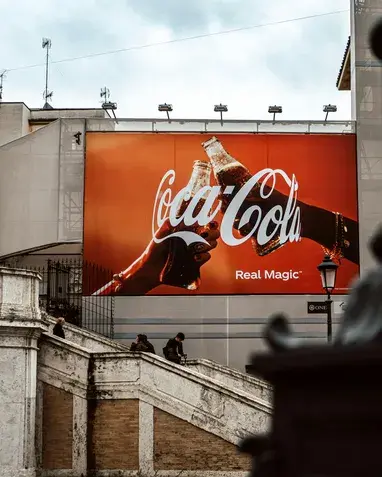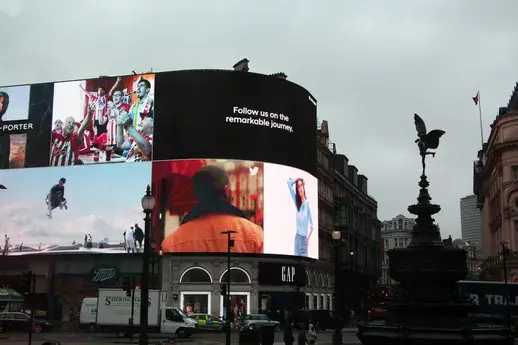

BFSI is the category where physical scale equals credibility, and credibility equals subscriber acquisition. Banks, insurers, and fintechs hand over no product the buyer can sample. The signup itself is the commitment. So the brand has to do the trust work before the buyer ever clicks "open account." A 40x20 hoarding in BKC Mumbai or on a high-rise wall in Manhattan does exactly that work, in a way no Instagram ad can match. That structural fact is why HDFC Bank, ICICI Bank, SBI, Axis Bank, Kotak Mahindra, IndusInd Bank, LIC, HDFC Life, ICICI Prudential, Bajaj Allianz, Tata AIA, Paytm, PhonePe, CRED, Groww, Zerodha, and Bajaj Finserv in India, and Chase, Bank of America, Capital One, Citi, Wells Fargo, American Express, GEICO, State Farm, Progressive, Allstate, USAA, and Liberty Mutual in the USA all spend disproportionately on OOH. For the category fundamentals behind this kind of trust-building buy, Out-of-home advertising is a useful starting reference.
The short version. Indian BFSI spends ₹1,200 to ₹1,800 crore a year on OOH. US BFSI spends $2.5 to $4 billion. The category-defining behaviour is premium-placement trust signaling. Big building wall, big logo, premium business district, top of the high-rise. The placement is the message. Insurance runs a different OOH variant focused on life-event emotional triggers. Fintechs like CRED and Paytm imported the bank playbook with twists.
This guide covers the trust-signal logic, the bank versus insurance split, fintech premium placement, US BFSI patterns, and a worked ₹10 lakh fintech Bangalore launch.
Why BFSI is a trust-led OOH category
Three structural reasons.
Multi-year commitment. A bank account, an insurance policy, a credit card, a mutual fund SIP all involve handing over money or signing a contract that lasts years. The buyer needs to trust the brand will still be there. Physical scale signals durability in a way no digital ad does.
No sample, no trial. Unlike FMCG (you can try a packet), automotive (you can test drive), or real estate (you can visit the site), BFSI has no try-before-you-buy. The brand has to be trusted before the first transaction. OOH builds that pre-transaction trust.
Regulatory inertia. Banks and insurers operate under regulators (RBI, SEBI, IRDAI, OCC, FDIC) that change rules slowly. The category does not lend itself to fast-iterating digital creative the way D2C does. Long-running trust-signal campaigns work better for the category than constantly-refreshing performance creative.
The 'big building, big logo' play
Look at the major business districts in any large city. BKC Mumbai, Cyber Hub Gurgaon, HITEC City Hyderabad, Bandra-Worli sea link, the high-rises in Manhattan midtown, the Magnificent Mile in Chicago, the Buckhead district in Atlanta. The hoarding inventory in these clusters is dominated by BFSI brands.
HDFC Bank's tower-top branding on its HQ in BKC, Citibank's hoardings on Park Avenue, Bank of America's logo on the BofA Tower NYC. These are not awareness placements in the traditional sense. They are scale declarations. The audience that drives past, walks past, or works inside these districts is the high-net-worth and salaried-professional segment that BFSI most wants to acquire.
Premium business district hoardings rent at ₹6 to ₹20 lakh per month in BKC and Cyber Hub, $25,000 to $80,000 in Manhattan midtown, $12,000 to $40,000 in San Francisco financial district. The category accepts these rates because the placement value is structural, not just impression-count.
The bank versus insurance creative split
Banking OOH tilts toward rate-led and feature-led messaging. Interest rates on savings, fixed deposit rates, premium credit card benefits, home loan offers, NRI banking features. Numbers and specifics. HDFC Bank's "HDFC Bank, We Understand Your World" combined with specific rate numbers is the template.
Insurance OOH tilts toward emotional and life-event-led messaging. Birth of a child (LIC's "jeevan" campaigns), marriage (HDFC Life new-couple plans), home ownership (home insurance), retirement, accidents (motor and health). The creative uses family imagery, life-stage milestones, and outcome-led copy. Bajaj Allianz's family-focused campaigns, GEICO's gecko, Progressive's Flo, State Farm's "good neighbor" all use emotional framing.
The same hoarding might carry an HDFC Bank rate-led message in January and an HDFC Life family-led message in April. The brand house is the same, the category creative differs.
Fintech premium placement
Fintechs in India face the trust ceiling more acutely than D2C brands because they are asking for banking access, not a t-shirt purchase. The structural answer for the category leaders has been heavy premium-placement OOH from very early in the lifecycle.
CRED ran premium hoardings in BKC, Cyber Hub, HSR Layout, and Banjara Hills from 2018 onwards. The estimated total OOH spend from 2019 to 2023 was ₹400 crore. The Indian Premier League sponsorship was a separate layer. The hoardings were not selling a feature, they were declaring that the brand was serious enough to occupy that placement.
Paytm spent ₹250 to ₹400 crore annually at peak years on a combination of premium hoardings, transit OOH, and dealer-tagged retail boards (Paytm Pay logos on neighbourhood shops counted as a distributed OOH layer).
PhonePe ₹150 to ₹250 crore annually with premium financial-district hoardings plus airport inventory.
Groww and Zerodha (mostly digital-led) added a modest premium OOH layer in 2023 to 2025 as they grew into more mainstream demographics. Bajaj Finserv runs heavy financial-district hoardings supporting both lending and insurance brands.
US BFSI OOH patterns
Chase. $300 to $450 million annually. Concentrated in NYC, LA, Chicago, Houston, and major business districts. Heavy investment in airport inventory at major hubs (JFK, LAX, ORD, DCA) for premium card positioning.
Bank of America. $250 to $400 million annually. Premium tower branding plus broad consumer-banking awareness across all major US metros.
American Express. $150 to $250 million annually, heavily in NYC midtown for premium card positioning. Amex's NYC subway saturation around the Centurion Lounge openings is a recent case.
GEICO and Progressive. Each spends $300 to $500 million annually with heavy national highway hoarding plus TV-integrated buys. The category is unusual because two insurers (GEICO and Progressive) consistently rank among the top ten total US ad spenders across all categories, and OOH is a meaningful slice.
State Farm and Allstate. $200 to $350 million each, more locally-tiered (state-level and regional metros).
Capital One, Citi. Each spends $150 to $300 million on premium business district plus airport.
The Detroit market, where AdTown has its deepest USA inventory, is interesting because it has strong BFSI demand from regional brands (Comerica, Flagstar, Huntington Bank, Citizens Bank) and significantly lower placement costs than coastal markets.
How BFSI uses airport inventory
Airports are disproportionately important for BFSI because the audience density of high-net-worth travelers, business travelers, and salaried professionals is highest there. American Express owns this category in US airports. HDFC Bank, ICICI Bank, and Kotak Mahindra dominate Indian metro airports.
A premium airport lounge hoarding in Mumbai T2 or Delhi T3 rents at ₹4 to ₹12 lakh per month. JFK Terminal 4 premium inventory hits $30,000 to $80,000 per month. The CPM is high. The audience match for premium banking and premium card products is exceptionally clean, which justifies the rate. The same retail-credibility logic that drives D2C OOH (covered in OOH advertising for e-commerce brands) applies even more strongly in BFSI because the trust stakes are higher.
Worked example: fintech Bangalore launch
Brand: a new Indian fintech app, B2C lending or investing positioning. Budget: ₹10 lakh across an 8-week launch window in Bangalore.
Spend plan:
- One premium hoarding in HSR Layout, business-district adjacent: ₹3,80,000 for two months = ₹7,60,000. Single placement carries 60% of budget but the credibility signal demands premium concentration.
- One premium hoarding on Outer Ring Road near Cessna Business Park / Embassy Tech Village: ₹1,60,000 for one month = ₹1,60,000.
- Wait, that totals ₹9,20,000 already on two boards. Add airport inventory.
- Bangalore Kempegowda Airport baggage claim hoarding: ₹70,000 for two weeks = (paid monthly, so prorated) about ₹50,000.
- Wait, ₹9,70,000 leaves only ₹30,000 for everything else. Rebalance.
Realistic ₹10 lakh shape:
- One premium HSR Layout business-district hoarding, 2 months: ₹3,80,000.
- One premium feeder hoarding on Outer Ring Road near tech parks, 2 months: ₹2,40,000.
- One Bangalore Airport baggage claim or pre-security hoarding, 4 weeks: ₹1,80,000.
- One mall LED at Phoenix Marketcity Whitefield (tech park spillover): ₹40,000 per month, 2 months = ₹80,000.
- Programmatic DOOH layer targeting tech-park-adjacent screens during morning and evening commute windows: ₹70,000 daily-spend cap across 6 weeks.
- Printing, monitoring: ₹50,000.
Total: ₹10,00,000.
Expected outcome: 14 to 22 lakh impressions across the launch window, with concentration in the tech-park commute audience that matches the fintech buyer profile. App store downloads attributable to the campaign typically 35,000 to 65,000 over 8 weeks. Conversion to funded accounts 10 to 18 percent, so 4,000 to 11,000 funded accounts at a campaign CAC of ₹100 to ₹250 per funded account, which is favorable against the ₹300 to ₹600 CAC range that Meta-only acquisition typically delivers for fintech in 2026.
For the broader question of agency versus direct buying when planning a BFSI OOH program at scale, do I need an advertising agency walks through the agency versus marketplace economics that apply heavily in this category. The marketplace logic (browse, compare, book direct without agency markup) is covered in outdoor advertising marketplace.
Common BFSI OOH mistakes
Wrong placement for the persona. A premium credit card on a tier 2 highway hoarding signals confusion. Premium financial products require premium placements. The match is part of the message.
Rate-led messaging without trust signal. A bank or insurer running offers without the brand-scale signal underneath finds the offer does not convert. The trust layer is what makes the rate work.
Cutting OOH in down quarters. Banks and insurers under pressure often cut OOH first. This is structurally wrong because trust is built by always being there. Brands like HDFC Bank that maintain OOH through cycles outperform peers in the recovery quarters.
Underinvesting in airport. The audience match for premium BFSI in airport inventory is among the cleanest in advertaising. Brands that skip airport leave high-value impressions on the table.
Same creative for too long. Even trust-signal campaigns need creative refresh every 8 to 12 weeks. The placement compounds but the creative decays without refresh.
Where AdTown fits
Browse premium business district hoardings, airport lounge and baggage claim inventory, mall LEDs in financial catchments, transit panels on commuter routes, and programmatic DOOH across Indian metros and US markets at /listings. The platform is particularly useful for the tactical regional layer that even large BFSI brands route outside the main agency, where the 15 to 22 percent markup on a high-rate premium hoarding translates to meaningful budget. Free for advertisers and owners for the first six months while we launch.
BFSI is the category where placement and impression-quality matter as much as impression count. The brands that get this right concentrate spend on the placements that read as credibility, not just on the placements that maximise CPM. That discipline is the entire category playbook.
See real prices in your city
Browse billboards, indoor screens, transit, cinema slots and more. Every listing shows the price, the location, and the photos upfront. No quotes, no salesperson.
Browse listingsFrequently asked questions
Because banking, insurance, and financial services are multi-year commitments where the buyer is handing over money or signing a long contract. Trust is the gate, and physical scale signals trust in a way digital cannot match. A bank's name on a 40x20 hoarding in BKC or on a high-rise wall in Manhattan reads as a brand large enough to still be there in ten years. HDFC Bank, ICICI Bank, SBI, Axis, LIC, GEICO, State Farm, Chase, and Bank of America all use this visible-scale logic. Fintechs (CRED, Paytm, PhonePe, Robinhood) borrowed it to build trust faster than digital alone would have allowed.
HDFC Bank spends an estimated ₹180 to ₹280 crore a year on OOH. ICICI Bank ₹150 to ₹220 crore. SBI ₹100 to ₹160 crore through public-sector channels. Axis Bank ₹80 to ₹140 crore. Kotak Mahindra ₹60 to ₹100 crore. LIC ₹120 to ₹200 crore. HDFC Life and ICICI Prudential ₹50 to ₹90 crore each. Bajaj Allianz, Tata AIA, Bajaj Finserv ₹40 to ₹80 crore each. Combined, the Indian BFSI category spends an estimated ₹1,200 to ₹1,800 crore a year on OOH, making it the fourth biggest category after real estate, FMCG, and automotive.
Fintechs faced the same credibility ceiling as D2C brands but with higher stakes. Users handing over banking access need to trust the brand more than users buying a t-shirt. Premium hoardings in BKC, Cyber Hub, HSR Layout, Banjara Hills, and Marina Bay signaled scale and seriousness in a way that resolved trust gaps faster than digital. CRED ran an estimated ₹400 crore on OOH between 2019 and 2023. Paytm ran ₹250 to ₹400 crore at its peak years. PhonePe ₹150 to ₹250 crore annually. The premium placement is itself the credibility signal, not just an awareness layer.
Insurance plays heavily on emotion and life events (birth of a child, home purchase, retirement, accidents). The hoarding creative reflects this with family imagery, life-stage milestones, and outcome-led messaging. LIC's 'jeevan' campaigns, Bajaj Allianz's family-focused messaging, GEICO's gecko mascot, and State Farm's 'good neighbor' creative all use emotional framing rather than rate-led messaging. Banking OOH, by contrast, tilts toward rate-led messaging (interest rates, account features, premium card benefits) and trust-signal placement. Insurance also runs heavier festival OOH (Akshaya Tritiya, Diwali) than banking does.
Chase spends an estimated $300 to $450 million annually on OOH, concentrated in NYC, LA, Chicago, Houston, and major business districts. Bank of America $250 to $400 million. Capital One $200 to $350 million. American Express $150 to $250 million, heavily in NYC midtown and major airports for premium card positioning. GEICO and Progressive each spend $300 to $500 million annually with heavy national highway and TV-OOH integrated buys. State Farm and Allstate $200 to $350 million each. The total US BFSI OOH category spend is $2.5 to $4 billion a year.
₹8 lakh to ₹40 lakh for a single-city soft launch. ₹50 lakh to ₹2 crore for a multi-city public launch. ₹2 to ₹6 crore for a national launch with celebrity spokesperson. The format mix tilts toward premium hoardings in financial-district catchments (BKC, Cyber Hub, HSR, Banjara Hills), airport lounge inventory, premium business district mall LEDs, and metro panels on commuter routes for white-collar workers. Smaller fintechs often start with two premium boards plus airport inventory rather than spreading thin across a city.